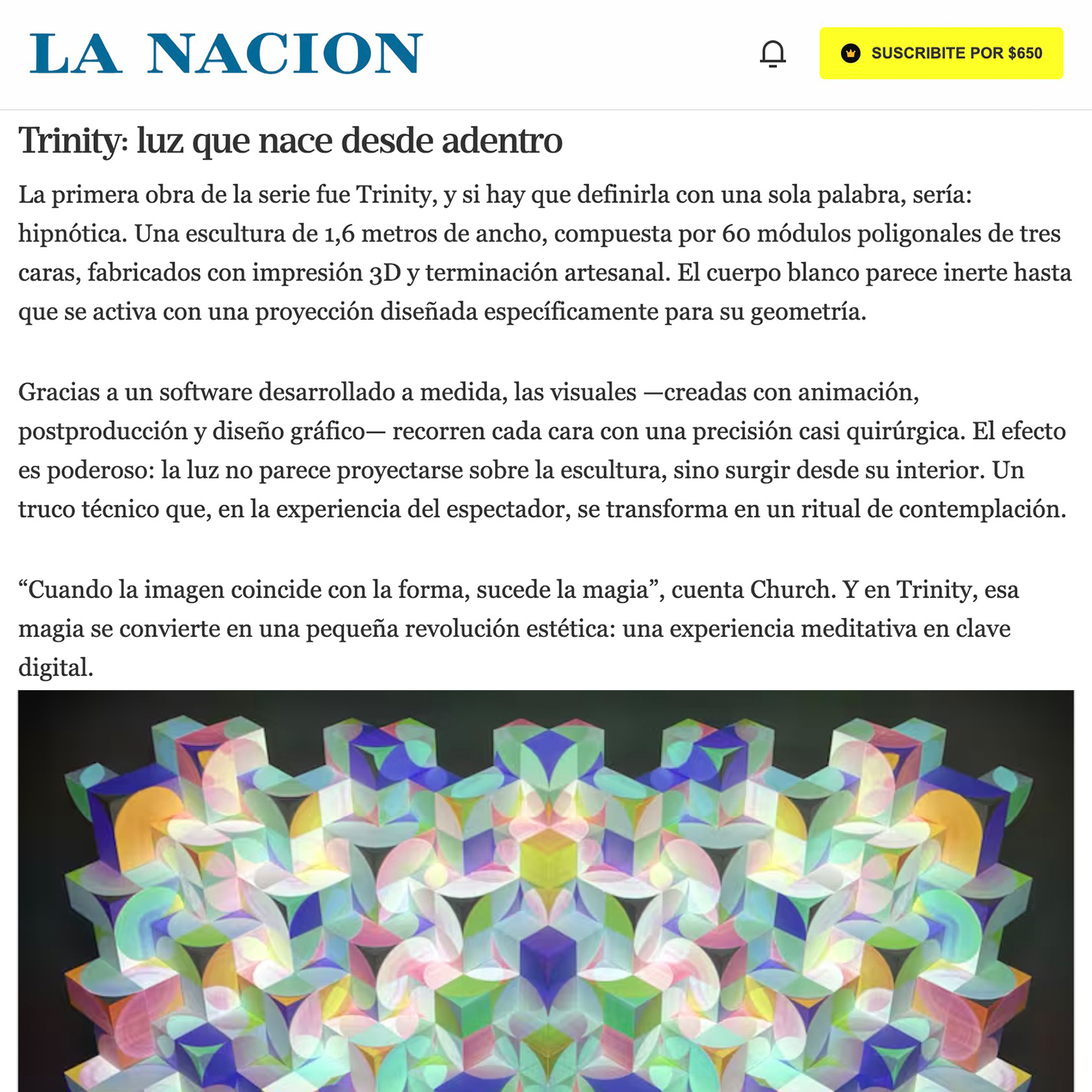

Emerging artist and self-taught inventor
Church is the sole creator of his light artworks. He has over 15 years of industry experience. Industrial Engineering graduate.
Argentina's first digital VJ
2001. Started experimenting with visualizers (Winamp's AVS and G-Force) and abstract animations, developing multi-screen systems and early projection mapping experiments at major electronic music festivals — before the term 'mapping' was even known.
Co-founder of Sasami
2004. Founded a technology-driven production company focused on audiovisual staging and projection mapping for brands and corporate events.
Sculptures for Projection Mapping
2017. He began designing sculptural structures specifically conceived for projection mapping, aiming to push the technique to its limits.
Development of light artworks
2021. Undertook a research process combining industrial design, animation, and programming to create light installations that generate a captivating experience.
Presentation of Trinity, a light installation
2025. The culmination of his process that crystallizes the exploration of geometry, light, and perception, merging the digital and the physical into immersive, contemplative experiences.
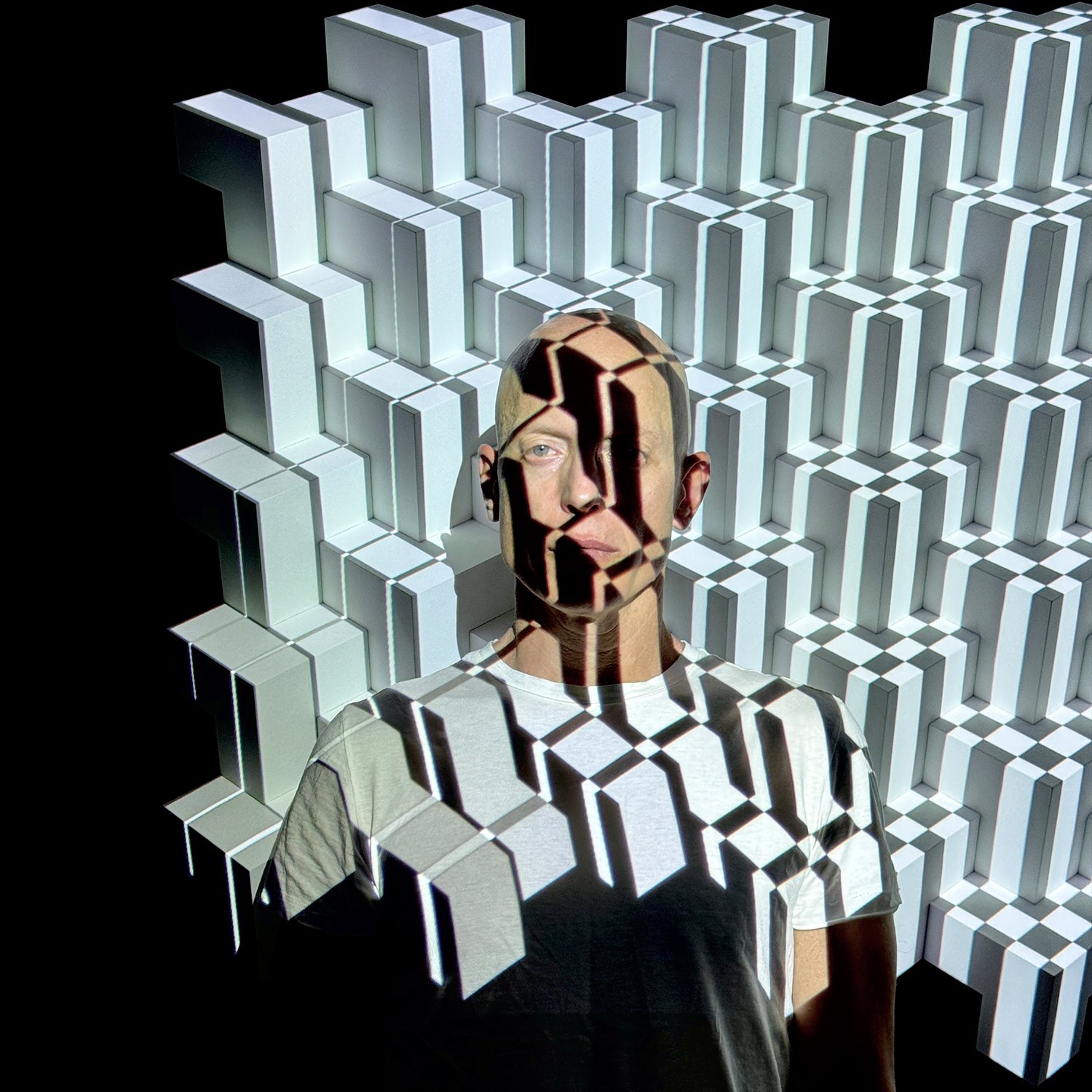
“ My work is rooted in a cosmological analogy: reality understood as a process of projection. Light, as it moves through different dimensions, becomes color, information, and ultimately experience. The works explore this transition between the intangible and the material, where perception becomes form.
I explore how light can become matter and how the lived experience transforms once geometry ceases to be static. I combine sculpture, digital animation, and software development to create installations where the technological serves the sensory.
Precision is not merely an obsession; it is a necessary condition for the illusion to occur—an illusion in which the visuals appear to have no alternative but to travel through the form, determined by the morphology of each installation.
The rules I impose make each digital piece function as its own universe, governed by internal laws.
The works do not narrate; they propose a state of contemplation. They are experiments about what we believe to be stable, and about the possibility of producing presence through light. ”
Church speaks slowly, sharing biographical and geometric details with warm clarity. Through his research translated into artwork, he offers us an adventure that undeniably invites and confronts. Within this journey, he works from a place where intellectual rigor and technology do not oppose sensibility, but rather amplify it.
His practice is organized like an expanding cartography: computational models, programming, and experimentation with light and color as active matter.
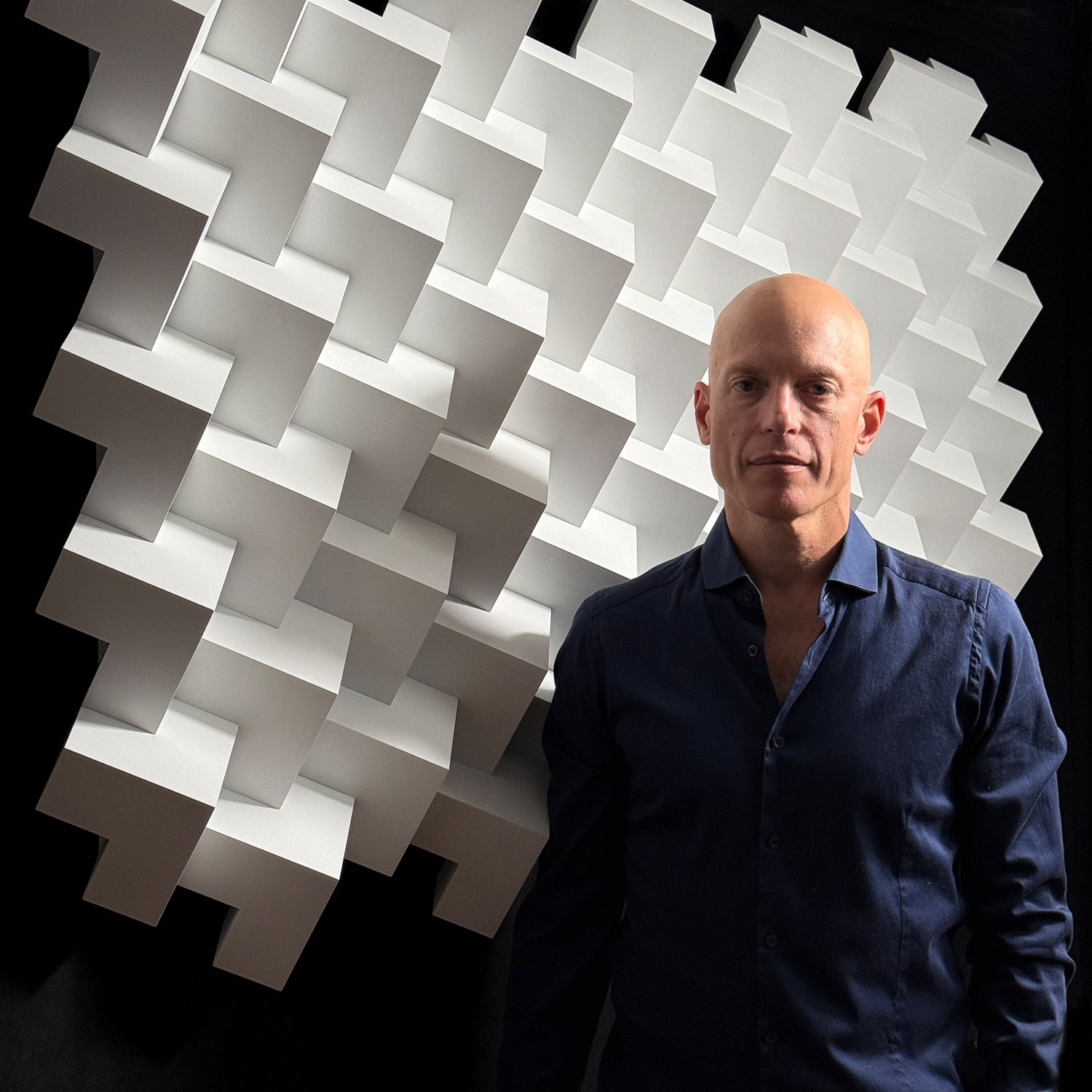
After an extensive period of work, trial and error combined with specific expertise, all bound together by deep analytical intuition, became the artwork. For this reason, Trinity is neither an immediate answer nor a single, clear-cut result, but the materialization of an architecture grounded in time, sustained by his training and a disciplined, searching attitude spanning design, playfulness, visual arts, and technological devices.
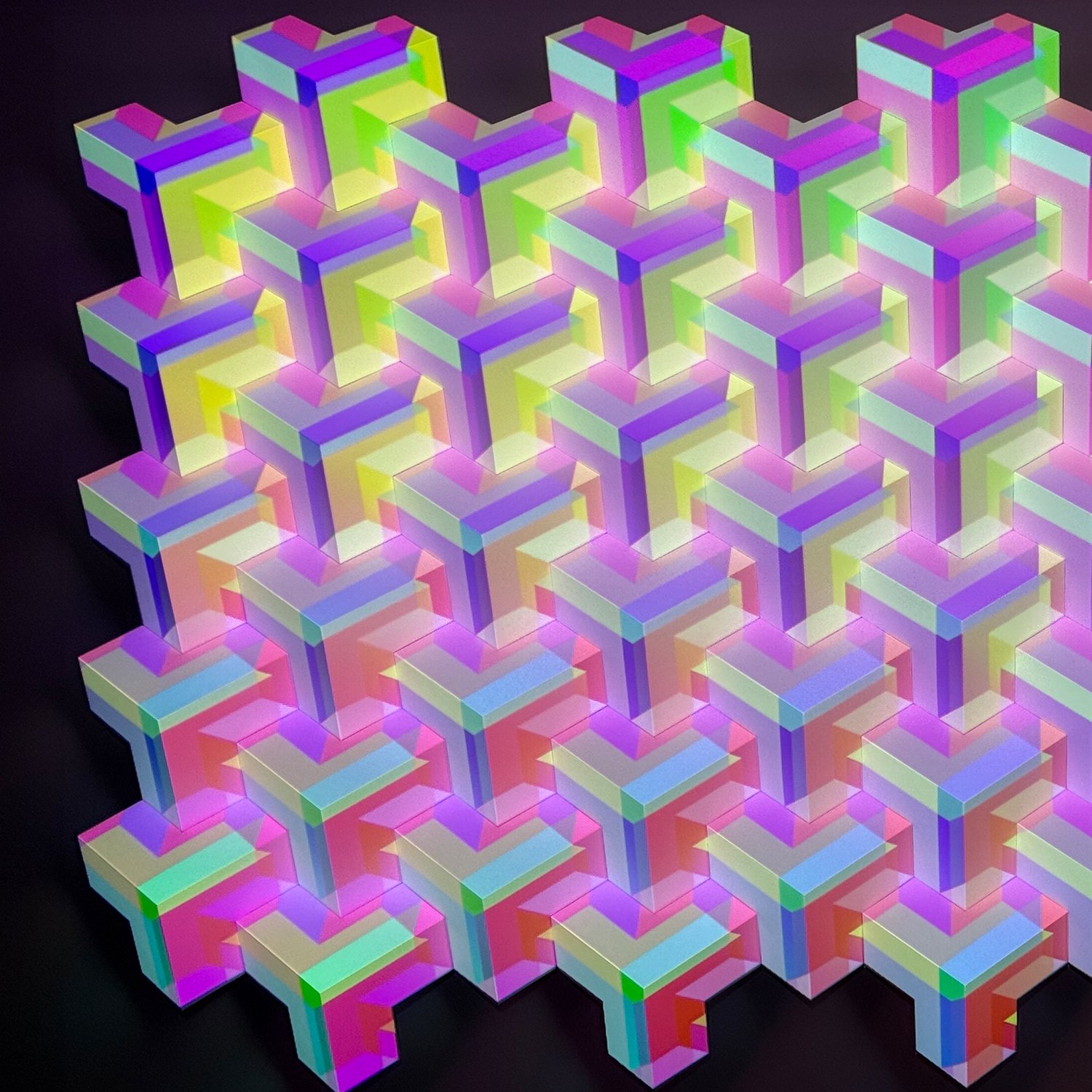
The work is composed of a wall-mounted support made of polyhedral volumes, a high-definition projector, and a digital structure that articulates lines, planes, and rhythms. Through a magical beam, the forms shift, appear, and reappear with variations that alter perception. Just when a stable sequence seems to emerge, the image withdraws and proposes another configuration. There is no narrative, no figurative representation: there is experience.
Here, geometry does not function as ornament or as an overt historical reference. It is structure and resonance. One inevitably thinks of traditions that understood abstraction as an inner dimension — from Kandinsky's principle of inner necessity to Malevich's pursuit of purity — and of the kinetic experiences of Soto or Kosice.
Church updates that legacy in a context where the energy created does not remain within the object, but instead circulates and unfolds in the space, between the observer and the projection.
Its ephemeral, sequential character is central: each configuration exists for a moment, then transforms. The piece is also presented as a multiple original, in a limited edition of 111 copies, defined in three possible scales. Far from being a mere technical detail, this number is tied to his own history, and through symmetry, it introduces mystery while also opening up questions: What happens when the variable is inscribed within a preset limit? How does scale affect the physical relationship between viewer, exhibition space, and projection? If we consider that each realization will be identical in its structure yet different in its individual or collective experience… and the journey continues…
In Trinity, this inner charge manifests in the precision of the geometric forms, in the immaterial beauty of color-light, in the subtle tensions produced with every change of direction or rhythm, in the margin of error that makes room for the unexpected. It is a work that interweaves the historical with poetics in motion, without fixed hierarchies.
For this reason, I believe the work summons 'the body' and places it within an introspective time that leaves the boundary between artwork and perception suspended.
Matter and content condense into the construction of a universe of his own, that of the artist — Church — and his many pursuits. Trinity, his work, a sensitive piece that transforms under the gaze and offers itself as an open field that, as it unfolds, seduces and cradles; one with the potential to grow and resonate, like an organism of light, within every viewer.
Marcela Furlani
Visual Artist
February 2026
“An artistic experiment that challenges the limits of what we understand as a ‘work of art.’”
“Here, what is exhibited is not hung: it is activated. What is looked at is not just seen: it is inhabited.”
Read the full article